Fallout from the War in Iran

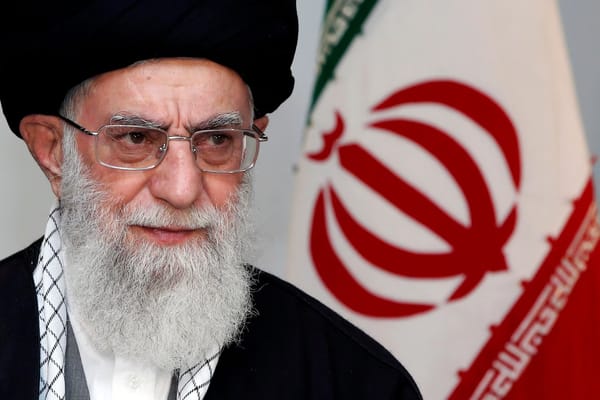
Last Saturday, the United States and Israel jointly launched Operation Epic Fury — a campaign explicitly aimed at toppling Iran's government — and preceded by the largest U.S. military buildup in the Middle East since the 2003 invasion of Iraq. The administration had warned Iran that failed nuclear talks in Geneva would carry consequences. Supreme Leader Ali Khamenei was killed in the opening strikes, abruptly ending his 37-year-long rule of Iran. An interim three-person council is now managing the country while the 88-member Assembly of Experts selects a successor. President Trump has said Iran's new leadership has reached out, seeking talks, though a senior Iranian official said Friday that Iran would not negotiate with the United States.
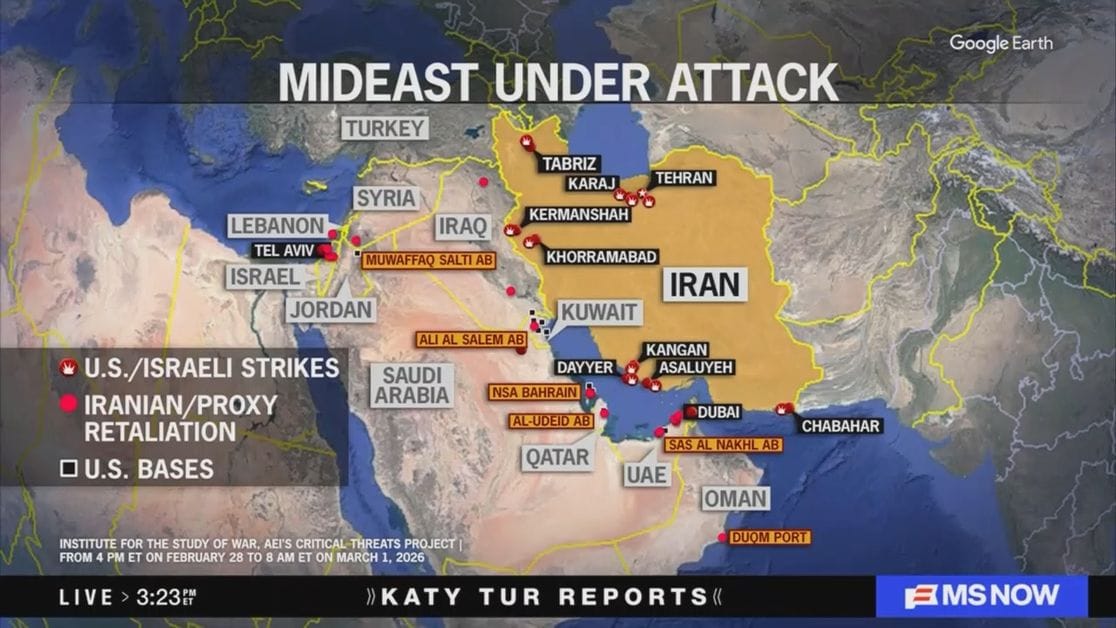
Iran's counter-attack has been sweeping and regional in scope. In the war's opening hours, Iran launched ballistic missiles and drones at Israel, the UAE, Bahrain, Kuwait, Qatar, and the Kurdish region of Iraq. Last Sunday, Iran expanded its strikes to Saudi Arabia and Oman, and debris from Iranian drones struck a Saudi oil refinery. Iran also targeted Amazon data centers, and the U.S. State Department closed its embassies in Saudi Arabia and Kuwait, prompting the U.S. to urge Americans to leave 14 countries across the region. On Wednesday night, Hezbollah entered the war, launching missiles and drones at Israel and opening a new front on the Lebanon border. Israel responded with massive airstrikes across Lebanon, including Beirut, killing several senior Hezbollah commanders.
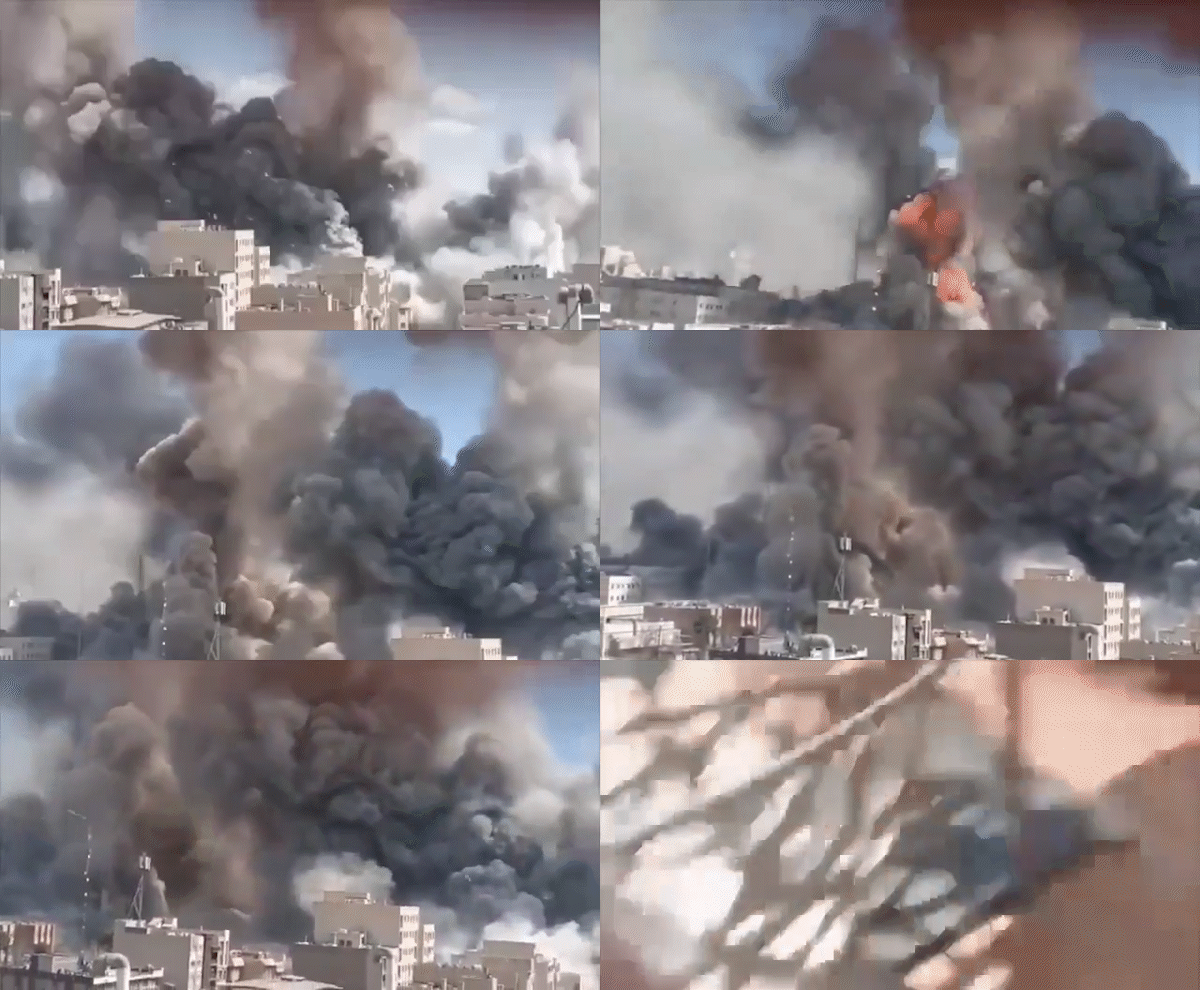
Early yesterday morning, President Trump said on Truth Social that Iran had agreed to cease bombing their Middle East neighbors, but that Iran would still be hit hard. Here’s footage from strikes on the oil depot in Iran later yesterday:
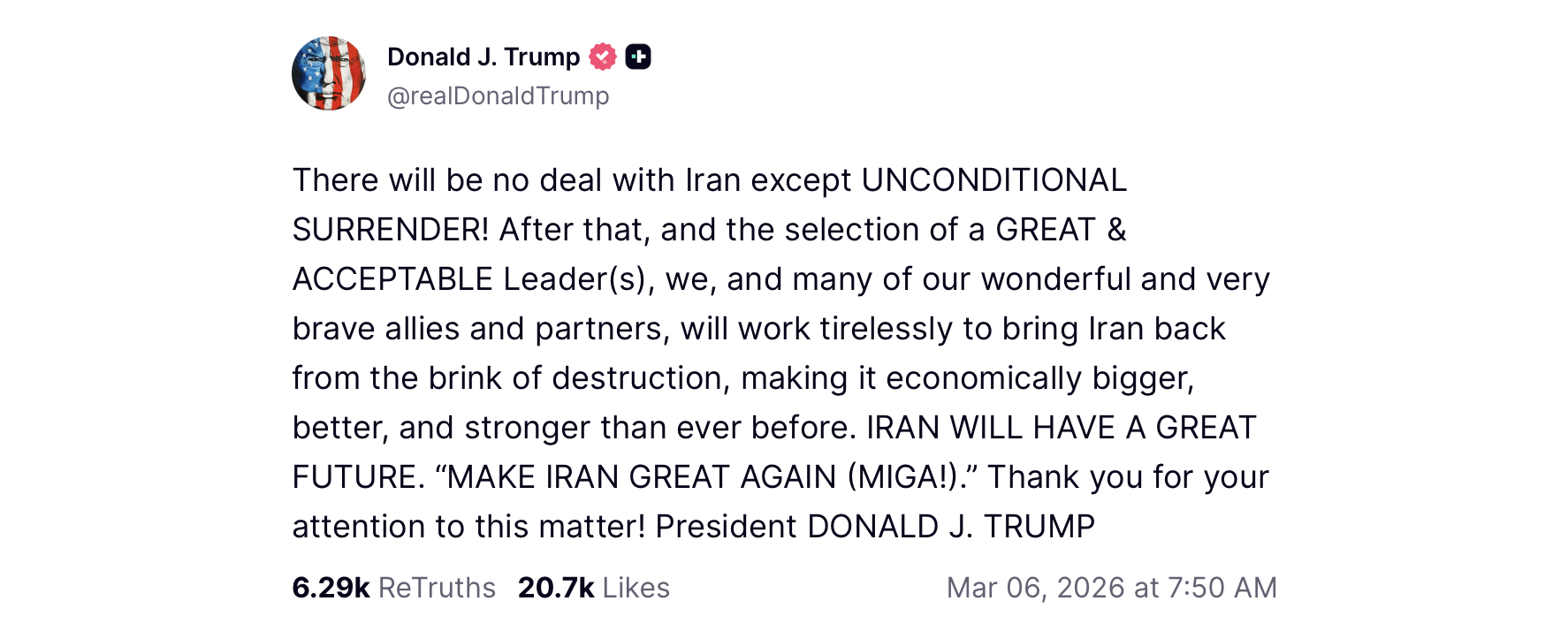
President Trump stated on Truth Social on Friday that he would only accept unconditional surrender from Iran, and he seemed to indicate that the U.S. would again engage in nation building in the Middle East.
🪖 Six American Soldiers Killed
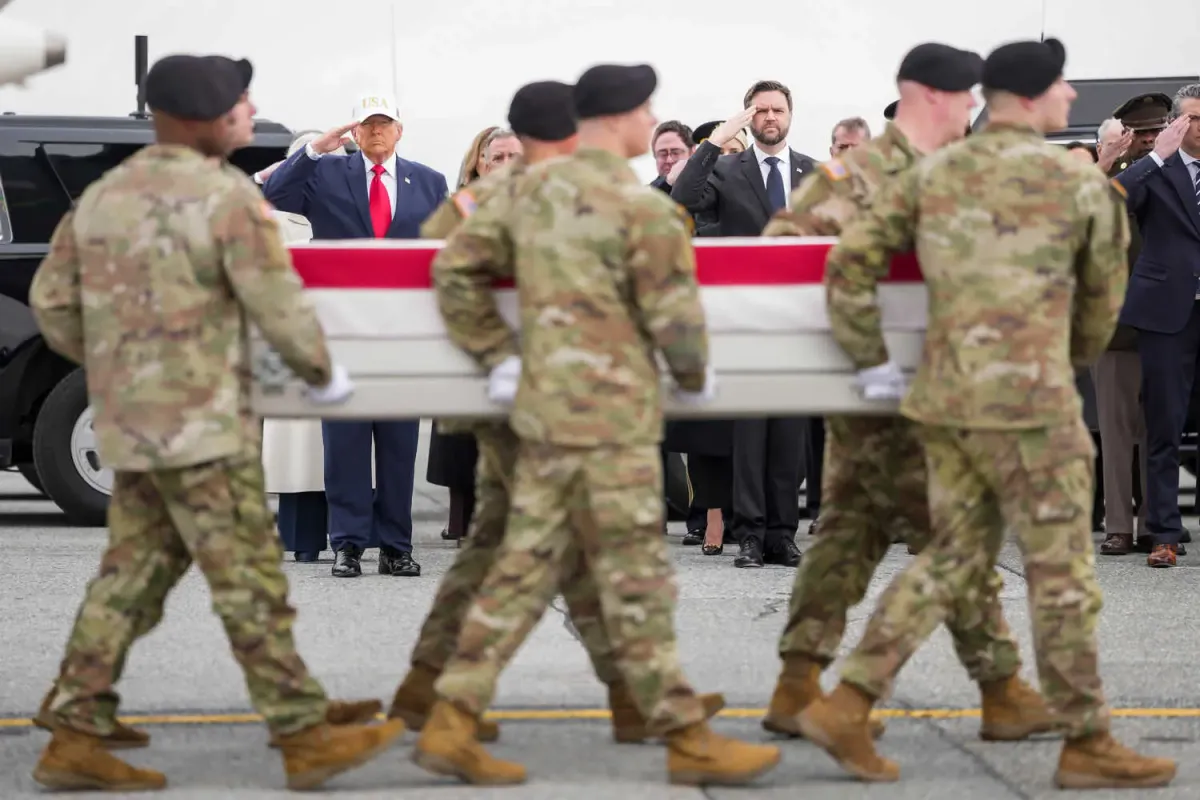
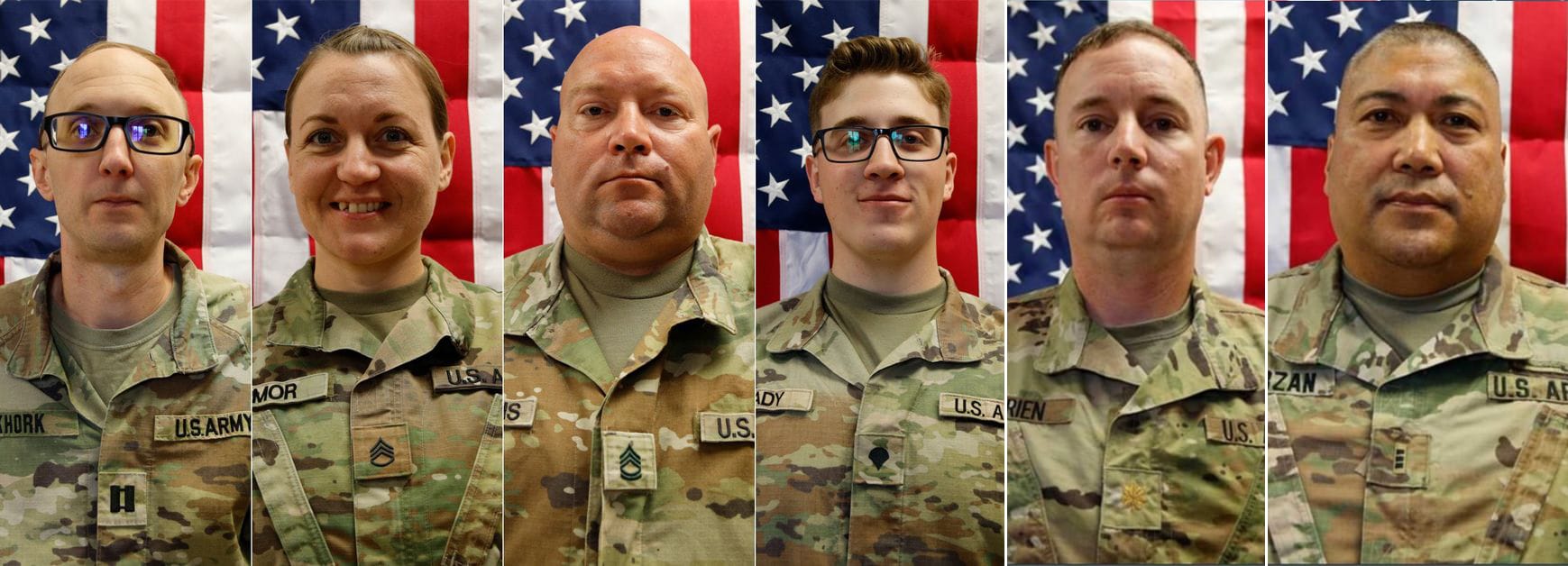
The Pentagon has confirmed that six U.S. service members have been killed since operations began last Saturday. Six Army Reserve soldiers — Captain Cody Khork, 35, of Winter Haven, Fla.; Sergeant 1st Class Noah Tietjens, 42, of Bellevue, Neb.; Sergeant 1st Class Nicole Amor, 39, of White Bear Lake, Minn.; Sergeant Declan Coady, 20, of West Des Moines, Iowa; Major Jeffrey O'Brien, 45, of Indianola, Iowa, and Chief Warrant Officer 3 Robert Marzan, 54, of Sacramento, Calif. — were killed when a drone struck Port Shuaiba, Kuwait on Sunday.
More service members have been seriously wounded, and several others sustained minor injuries. “Sadly, there will likely be more before it ends,” President Trump said in a video statement Thursday, vowing to “avenge their deaths.” The Iranian Red Crescent reports more than 550 Iranians have been killed.
🔎 Why Now?
According to Axios reporting, the trigger for the war came on Monday, February 23, when Netanyahu called President Trump with intelligence that Khamenei and his entire inner circle would be gathered at a single location in Tehran the following Saturday — a target of opportunity too tempting to pass up. The CIA confirmed the tip, and by Thursday, Jared Kushner and Steve Witkoff returned from Geneva with a blunt assessment that nuclear negotiations were going nowhere. At 3:38 P.M. Friday, Trump gave the final order. The original plan had reportedly called for strikes in late March or early April — giving the White House time to build public support — but Netanyahu pushed to move faster, leaving the administration in the position of justifying the war after the bombs had already fallen.
🇮🇱 Did Israel Push the U.S. into Starting a War?
On the issue of Netanyahu pushing to move faster, Secretary of State Marco Rubio sparked a firestorm — mostly from within his own party — when he told reporters:
“The President made the very wise decision—we knew that there was going to be an Israeli action, we knew that that would precipitate an attack against American forces, and we knew that if we didn’t preemptively go after them before they launched those attacks, we would suffer higher casualties.”
The remarks were widely interpreted as the U.S. admitting it had been pulled into war by a smaller ally that it arms and funds, with some arguing the President had become captured by the military hawks he ran against. President Trump and other U.S. officials pushed back, saying Trump ordered the strikes regardless of Israel’s intentions because Iran was negotiating a nuclear deal in bad faith and rebuilding its offensive capabilities too rapidly.
Israel’s president went on TV following the strikes and said that Iran's "ballistic missile program and atomic bomb program" would have soon been "immune" to attack without Operation Epic Fury, causing some to question how Iran's weapons program had been "obliterated” and nine months later rebuilt and nearly “immune” to attack.
⛽ Oil Prices Spike
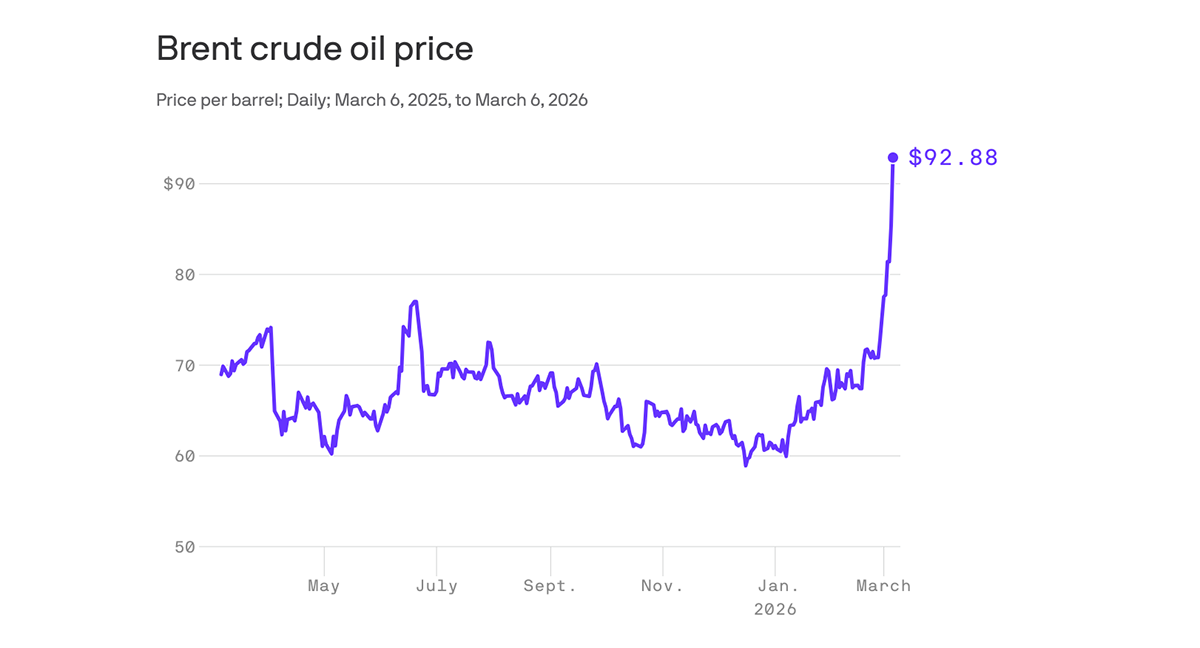
Iran has vowed that “not a single drop of oil” will move through the Strait of Hormuz — a chokepoint through which roughly one-fifth of the world's oil supply passes — and markets have responded sharply. Brent crude topped $90 Friday, up about 25% since the war began last Saturday, and U.S. average regular gas prices jumped 32 cents this week to $3.32 per gallon. President Trump ordered the U.S. Development Finance Corporation to provide political risk insurance for maritime trade and said the U.S. Navy will begin escorting tankers through the strait “as soon as possible,”declaring that the United States will ensure the “free flow of energy to the world.”
🪖 Will the U.S. Put Troops on the Ground in Iran?
President Trump declined Monday to rule out deploying ground troops to Iran. “I don't have the yips with respect to boots on the ground,” he told the New York Post, pointedly breaking from the familiar presidential formula of promising no ground deployment. The U.S. is sending additional troops and fighter jets to the region. Defense Secretary Pete Hegseth insisted the conflict would not become another prolonged war: "This is not Iraq. This is not endless."
Complicating the matter, the administration has offered multiple, conflicting visions of what a successful outcome from the war looks like. These have ranged from allowing the Iranian people to choose their own government, to ruling out regime change entirely, to (most recently from the President himself) selecting any new Iranian leader personally. Whatever the goal, a ground deployment would make it hard to imagine the conflict wrapping up in weeks rather than months or years.
📊 Is the War Popular?
While the Ayatollah Ali Khamenei has enjoyed a popularity in the U.S. of about 6%, polls taken before and after Saturday's strikes show that a majority of Americans oppose military action in Iran. Roughly 56% disapproved in a CNN poll, with Reuters/Ipsos and Washington Post surveys showing similar results. An earlier YouGov poll found nearly half of Americans strongly or somewhat disapprove, including 78% of Democrats, 55% of independents, and 24% of Republicans.
Other polls from Politico and Fox News indicate that support has increased recently to roughly 50%. Other news sources note that a majority support the action when the question is framed, “should Iran have nuclear weapons and should the U.S. act to stop that?”
More News
👮♀️ Noem fired, Mullin tapped: Trump fired Homeland Security Secretary Kristi Noem this week — the first cabinet firing of his second term — after advisers unanimously told him it was time for her to go, citing disastrous congressional hearings, the controversial purchase of two luxury Gulfstream jets and a Boeing Business Jet 737 with a planned cost of over $270 million using deportation funds, $220 million on an ad campaign featuring herself, a reported affair with top aide Corey Lewandowski, and the fatal shooting of two U.S. citizens during an immigration operation in Minneapolis. President Trump announced the nomination of Senator Markwayne Mullin (R-Okla.) as her replacement, while Noem will become Special Envoy for the Shield of the Americas, a role whose duties remain unclear.
🗳️ Texas primaries: Texas held primaries Tuesday with notable results up and down the ballot. In the Democratic primary, James Talarico beat Rep. Jasmine Crockett. In the Republican primary, incumbent John Cornyn is headed to a runoff against former AG Ken Paxton; Rep. Dan Crenshaw lost his House seat by more than 15 points to ultraconservative state Rep. Steve Toth; and Rep. Tony Gonzales, facing scrutiny over an affair with a staffer who later died by suicide, was forced into a runoff against hard-line conservative YouTuber Brandon Herrera and has since dropped out of the race.
📺 Ellison builds media empire: On February 26, Netflix walked away from the bidding war for Warner Bros. Discovery, handing Larry and David Ellison control of CNN, HBO, and Hollywood's two most storied studios, Warner Bros. and Paramount. Paramount's David Ellison had reportedly assured Trump officials he would make sweeping changes to CNN. Combined with the Ellisons' new acquisitions of CBS and TikTok, they hold unprecedented sway over the news and entertainment that Americans watch.
📉 Jobs report: The economy shed 92,000 jobs in February — the biggest monthly loss since October — pushing unemployment up to 4.4%, and revisions revealed December employment actually fell by 17,000 rather than growing by 48,000 as initially reported. Over the last three months, employers added an average of only 6,000 jobs per month, in an economy with 158 million total workers, a near-standstill that predates any economic turbulence from the Iran war.